<?xml version="1.0" encoding="utf-8"?>
<feed xmlns="http://www.w3.org/2005/Atom">
    <title>Girish Kumar - Blog</title>
    <link href="https://girishky.com/"/>
    <link href="https://girishky.com/feed.xml" rel="self"/>
    <updated>2026-05-26T12:00:00Z</updated>
    <id>https://girishky.com/feed.xml</id>
<entry>
    <title>Solving B-physics anomalies with axion-like particles and sterile neutrinos</title>
    <id>https://girishky.com/blog/solving-B-anomalies-with-ALPs-paper/</id>
    <published>2026-05-26T12:00:00Z</published>
    <updated>2026-05-26T12:00:00Z</updated>
    <author><name>Girish Kumar</name></author>
    <link href="https://girishky.com/blog/solving-B-anomalies-with-ALPs-paper/" rel="alternate"/>
    <summary></summary>
    <content type="html"><![CDATA[<p>In particle physics, we spend a lot of time looking for discrepancies between what we measure in the lab and what our theories predict. In <a href="https://arxiv.org/abs/2605.24713">a new paper</a>, my collaborators and I looked at two such anomalies in <span class="katex"><math xmlns="http://www.w3.org/1998/Math/MathML"><semantics><mrow><mi>B</mi></mrow><annotation encoding="application/x-tex">B</annotation></semantics></math></span> meson data.</p>
<p>The first is a long-standing puzzle known as the <span class="katex"><math xmlns="http://www.w3.org/1998/Math/MathML"><semantics><mrow><mi>B</mi><mo>→</mo><mi>π</mi><mi>K</mi></mrow><annotation encoding="application/x-tex">B \to \pi K</annotation></semantics></math></span> anomaly. For years, we have seen a persistent tension between experimental data from four <span class="katex"><math xmlns="http://www.w3.org/1998/Math/MathML"><semantics><mrow><mi>B</mi><mo>→</mo><mi>π</mi><mi>K</mi></mrow><annotation encoding="application/x-tex">B \to \pi K</annotation></semantics></math></span> decay modes and what the Standard Model (SM) predicts. In the SM, these decays are governed by tree and penguin diagrams. <a href="https://en.wikipedia.org/wiki/Isospin">Isospin symmetry</a> dictates that these decays should follow very specific patterns. But the measurements do not align with the predictions, leaving us with a puzzle that may hint at new physics beyond the SM.</p>
<p>The second is a more recent anomaly. In 2023, the <a href="https://inspirehep.net/literature/2725943">Belle II collaboration measured</a> the decay <span class="katex"><math xmlns="http://www.w3.org/1998/Math/MathML"><semantics><mrow><msup><mi>B</mi><mo>+</mo></msup><mo>→</mo><msup><mi>K</mi><mo>+</mo></msup><mi>ν</mi><mover accent="true"><mi>ν</mi><mo>ˉ</mo></mover></mrow><annotation encoding="application/x-tex">B^+ \to K^+ \nu\bar\nu</annotation></semantics></math></span> and found it to be about 3 standard deviations higher than expected. Essentially, <span class="katex"><math xmlns="http://www.w3.org/1998/Math/MathML"><semantics><mrow><mi>B</mi></mrow><annotation encoding="application/x-tex">B</annotation></semantics></math></span> mesons were found to decay into a kaon and invisible neutrinos more often than the SM expects.</p>
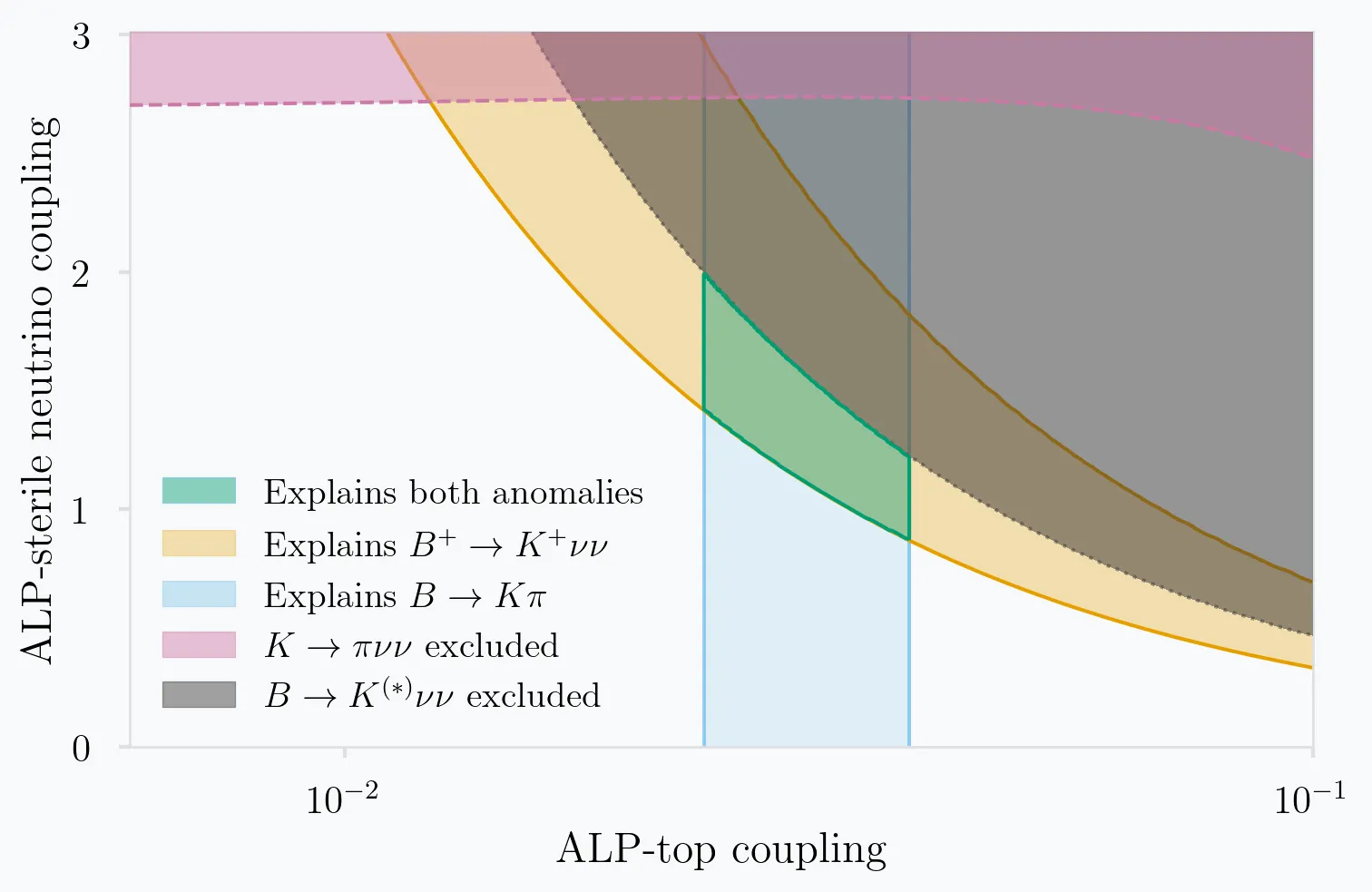
<p>In our paper, we propose a single way to solve both anomalies by introducing two hypothetical particles: an axion-like particle (ALP) and a heavy sterile neutrino. Our model has a specific feature: the ALP mass is almost identical to that of the neutral pion. Because they share the same quantum numbers, they can mix. This means if you produce an ALP, there is a finite probability it will transform into a neutral pion, and vice versa.</p>
<p>There are other papers that use ALPs to solve one or both of these anomalies, but our approach differs in two ways. First, we do not introduce direct flavor-changing couplings into the ALP model. Instead, the ALP couples only to the top quark and sterile neutrinos. This means the flavor-changing effects needed to fix these anomalies only appear indirectly through quantum loops. Second, our ALP has an incredibly short lifetime, about 10 femtoseconds. It disappears almost instantly, mixing into a neutral pion which then decays into two photons.</p>
<p>No model is perfect. Our fit for the total decay rate of <span class="katex"><math xmlns="http://www.w3.org/1998/Math/MathML"><semantics><mrow><msup><mi>B</mi><mo>+</mo></msup><mo>→</mo><msup><mi>K</mi><mo>+</mo></msup><mi>ν</mi><mover accent="true"><mi>ν</mi><mo>ˉ</mo></mover></mrow><annotation encoding="application/x-tex">B^+ \to K^+ \nu\bar\nu</annotation></semantics></math></span> is good, but it does not perfectly match the shape of the energy spectrum. Even so, it provides a significantly better description than the SM.</p>
<p><img src="https://girishky.com/assets/images/alp_btopik_btoknunu_params.webp" alt="" title="Parameter space showing the allowed region for ALP couplings"></p>
<p>Our model makes a couple of bold predictions that can be tested soon. It predicts a sterile neutrino of mass close to 690 MeV. It also suggests that related decays, such as those producing an excited kaon (<span class="katex"><math xmlns="http://www.w3.org/1998/Math/MathML"><semantics><mrow><msup><mi>K</mi><mo>∗</mo></msup></mrow><annotation encoding="application/x-tex">K^*</annotation></semantics></math></span>) and invisible neutrinos, should show an enhancement over SM predictions. The second point is particularly exciting because Belle II could potentially test it soon. Right now, we only have upper limits for those decays. If they are found to be enhanced, it would be a strong sign that this model is on the right track. Fingers crossed!</p>]]></content>
</entry>
<entry>
    <title>Pheno 2026</title>
    <id>https://girishky.com/blog/pheno-2026/</id>
    <published>2026-05-16T12:00:00Z</published>
    <updated>2026-05-16T12:00:00Z</updated>
    <author><name>Girish Kumar</name></author>
    <link href="https://girishky.com/blog/pheno-2026/" rel="alternate"/>
    <summary>On attending the 2026 Pheno conference</summary>
    <content type="html"><![CDATA[<p><img src="https://girishky.com/assets/images/2026-riverwalk-Pittsburgh.webp" alt="Riverwalk view in Pittsburgh near Point State Park"></p>
<p>This week I was at the University of Pittsburgh for the Phenomenology 2026 Symposium (Pheno), where I gave a talk on my recent work on light axion-like particles and lepton flavor violation in muonic atoms. I wrote about this work in <a href="https://girishky.com/blog/lfv-muonic-atom-paper/">my previous post on muonic atoms</a>, and you can find the paper on <a href="https://arxiv.org/abs/2604.07481">arXiv</a>.</p>
<p>The conference was three days long and had great talks throughout. I especially liked those on the topics of quantum information theory and machine learning applications in high-energy physics, areas I have not had a chance to work on yet. Beyond Pheno, Pittsburgh itself made for a pleasant visit. We stayed downtown and got to see many beautiful buildings. One evening, my wife and I visited Point State Park where the three rivers meet. We took a nice stroll along the riverside. The photo above is from that walk. I would certainly like to return for the conference in the future.</p>]]></content>
</entry>
<entry>
    <title>Searching for new physics in muonic atoms</title>
    <id>https://girishky.com/blog/lfv-muonic-atom-paper/</id>
    <published>2026-05-07T12:00:00Z</published>
    <updated>2026-05-07T12:00:00Z</updated>
    <author><name>Girish Kumar</name></author>
    <link href="https://girishky.com/blog/lfv-muonic-atom-paper/" rel="alternate"/>
    <summary>A brief overview of my paper about ALP-mediated LFV transitions in muonic atoms.</summary>
    <content type="html"><![CDATA[<p>Neutrino oscillations have proven that lepton flavor is not conserved, but we have yet to observe lepton flavor violation (LFV) in the decays of charged leptons. The Standard Model predicts<sup id="fnref-1"><a class="footnote-ref" href="#fn-1">1</a></sup> that processes like the muon decay <span class="katex"><math xmlns="http://www.w3.org/1998/Math/MathML"><semantics><mrow><mi>μ</mi><mo>→</mo><mi>e</mi><mi>γ</mi></mrow><annotation encoding="application/x-tex">\mu \to e \gamma</annotation></semantics></math></span> are too rare for current or near-future experiments to detect. This, however, creates opportunities to search for new physics. Since the Standard Model expectation is essentially nil, any detected signal would be clear evidence of physics beyond our current understanding.</p>
<p>Recently, Professor Alexey Petrov and I investigated a rare LFV process in muonic atoms<sup id="fnref-2"><a class="footnote-ref" href="#fn-2">2</a></sup>. In these systems, in the presence of appropriate new physics,  a captured muon can scatter with a bound electron to produce two electrons. The rate of this process scales with the cube of the effective nuclear charge, which means that searches in heavy atoms, like lead, are more promising due to the increased overlap between muon and electron wave functions. Koike and colleagues first <a href="https://inspirehep.net/literature/848026">proposed</a> this process in 2010.</p>
<p>Earlier studies focused on heavy new physics frameworks. We chose to explore the effect of light new physics particles, specifically axion-like particles (ALPs). Since light mediators avoid the suppression associated with high mass scales, we hoped the process rate would be sufficiently large. While this appeared promising in theory, light ALPs face severe constraints from flavor, astrophysics, and beam dump experiments. After including these bounds, our scan of the parameter space showed that for aluminum, the maximum surviving branching ratio remains small, at roughly <span class="katex"><math xmlns="http://www.w3.org/1998/Math/MathML"><semantics><mrow><msup><mn>10</mn><mrow><mo>−</mo><mn>20</mn></mrow></msup></mrow><annotation encoding="application/x-tex">10^{-20}</annotation></semantics></math></span>. See our <a href="https://inspirehep.net/literature/3142500">paper</a> for details.</p>
<p>Although this process may not be the primary discovery channel for light particles like ALPs, it remains a useful complementary probe. Upcoming experiments such as <a href="https://en.wikipedia.org/wiki/Mu2e">Mu2e</a> at Fermilab and <a href="https://en.wikipedia.org/wiki/Comet_%28experiment%29">COMET</a> at J-PARC are designed for stopped muons and can search for this specific two-electron signature.</p>
<section class="footnotes" aria-label="Footnotes">
<ol>
<li id="fn-1">This assumes neutrinos gain mass via the same mechanism as, say, the electron. In the Standard Model with massless neutrinos, lepton flavor is conserved. <a class="footnote-backref" href="#fnref-1" aria-label="Back to reference">&#8617;</a></li>
<li id="fn-2">Muonic atoms are <a href="https://en.wikipedia.org/wiki/Exotic_atom">exotic atoms</a> in which a captured muon replaces one of the electrons and orbits the nucleus. <a class="footnote-backref" href="#fnref-2" aria-label="Back to reference">&#8617;</a></li>
</ol>
</section>]]></content>
</entry>
</feed>