Solving -physics anomalies with axion-like particles and sterile neutrinos
In particle physics, we spend a lot of time looking for discrepancies between what we measure in the lab and what our theories predict. In a new paper, my collaborators and I looked at two such anomalies in meson data.
The first is a long-standing puzzle known as the anomaly. For years, we have seen a persistent tension between experimental data from four decay modes and what the Standard Model (SM) predicts. In the SM, these decays are governed by tree and penguin diagrams. Isospin symmetry dictates that these decays should follow very specific patterns. But the measurements do not align with the predictions, leaving us with a puzzle that may hint at new physics beyond the SM.
The second is a more recent anomaly. In 2023, the Belle II collaboration measured the decay and found it to be about 3 standard deviations higher than expected. Essentially, mesons were found to decay into a kaon and invisible neutrinos more often than the SM expects.
In our paper, we propose a single way to solve both anomalies by introducing two hypothetical particles: an axion-like particle (ALP) and a heavy sterile neutrino. Our model has a specific feature: the ALP mass is almost identical to that of the neutral pion. Because they share the same quantum numbers, they can mix. This means if you produce an ALP, there is a finite probability it will transform into a neutral pion, and vice versa.
There are other papers that use ALPs to solve one or both of these anomalies, but our approach differs in two ways. First, we do not introduce direct flavor-changing couplings into the ALP model. Instead, the ALP couples only to the top quark and sterile neutrinos. This means the flavor-changing effects needed to fix these anomalies only appear indirectly through quantum loops. Second, our ALP has an incredibly short lifetime, about 10 femtoseconds. It disappears almost instantly, mixing into a neutral pion which then decays into two photons.
No model is perfect. Our fit for the total decay rate of is good, but it does not perfectly match the shape of the energy spectrum. Even so, it provides a significantly better description than the SM.
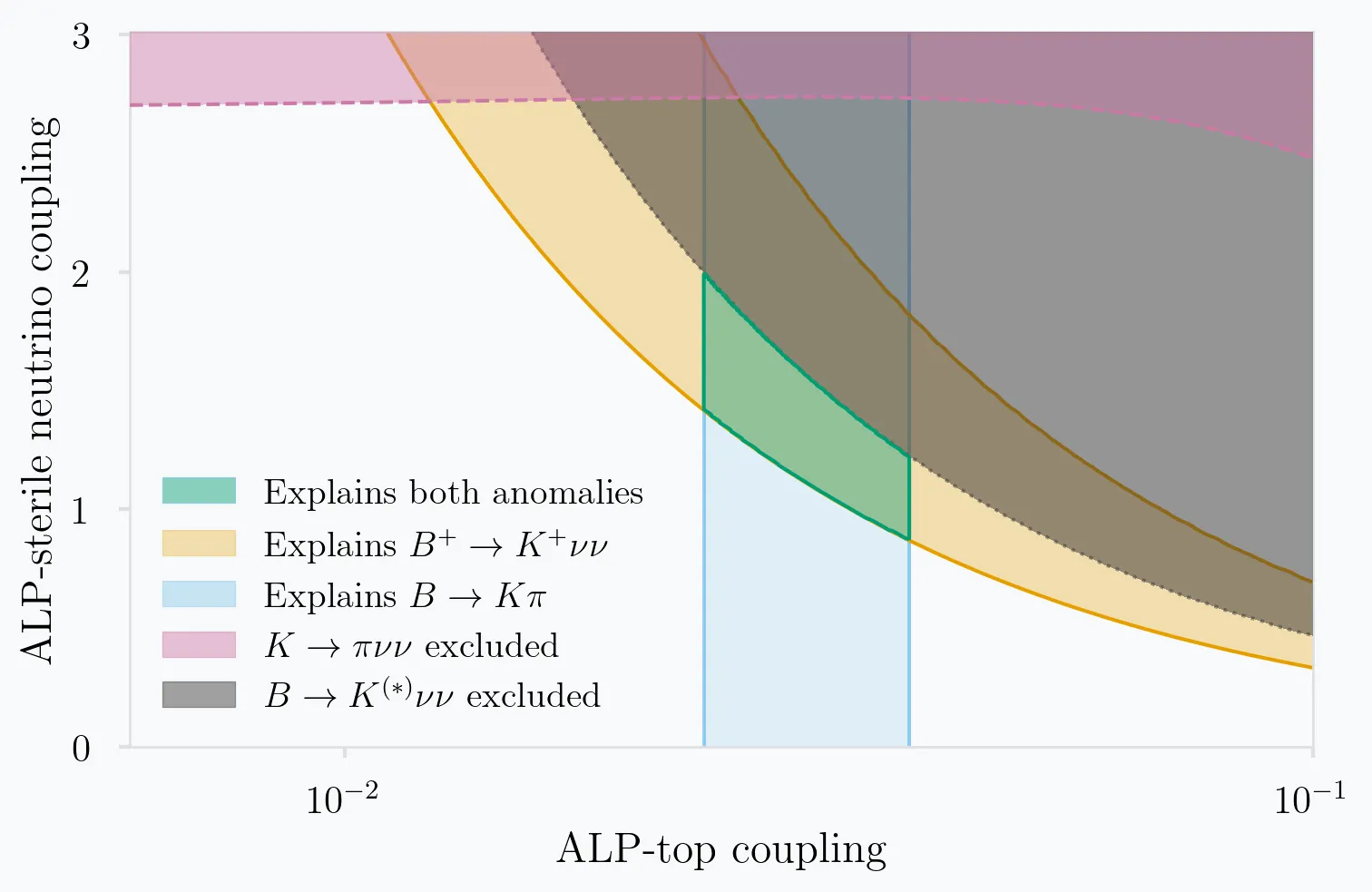
Our model makes a couple of bold predictions that can be tested soon. It predicts a sterile neutrino of mass close to 690 MeV. It also suggests that related decays, such as those producing an excited kaon () and invisible neutrinos, should show an enhancement over SM predictions. The second point is particularly exciting because Belle II could potentially test it soon. Right now, we only have upper limits for those decays. If they are found to be enhanced, it would be a strong sign that this model is on the right track. Fingers crossed!